NCGA Visits CCSA, Cosmopolitan University to Strengthen Cassava Research and Climate-Smart Agriculture
NCGA Visits CCSA, Cosmopolitan University to Strengthen Cassava Research and Climate-Smart Agriculture
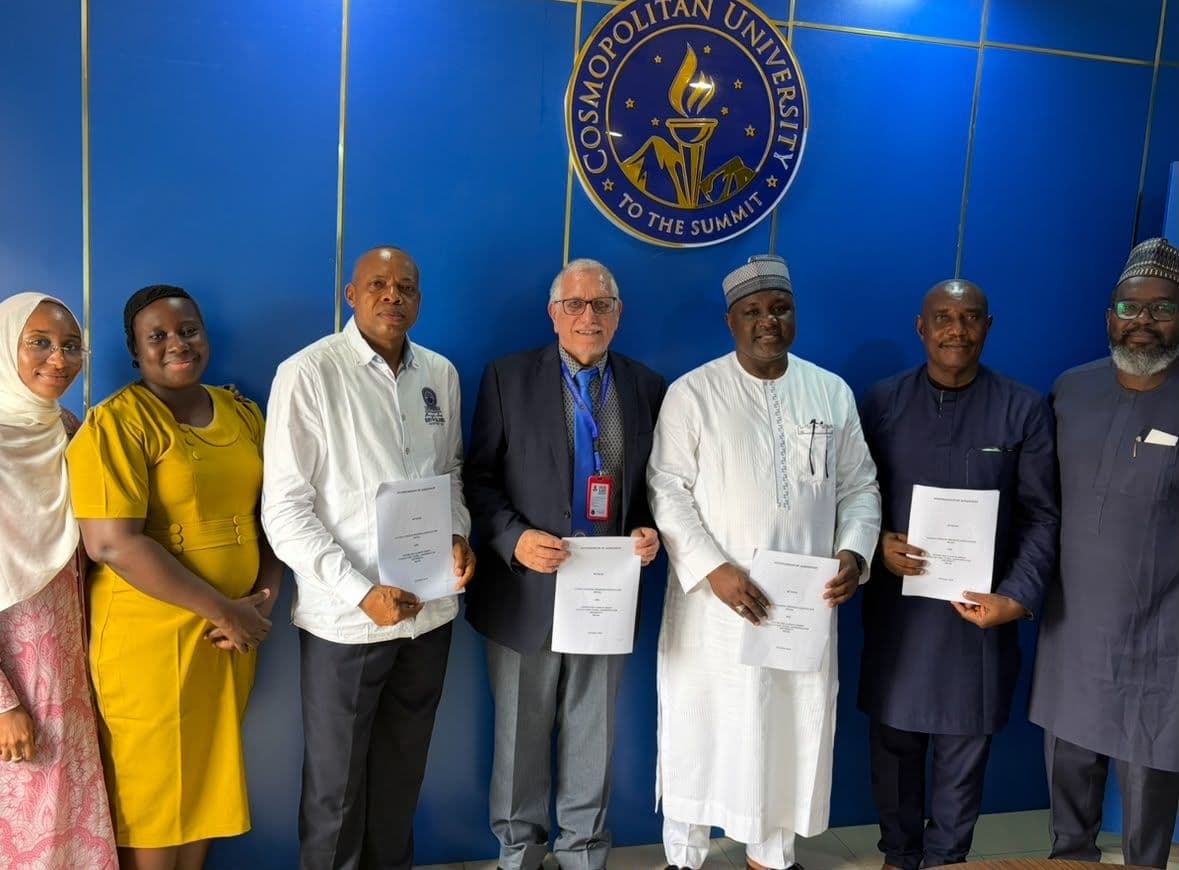
The Nigerian Cassava Growers Association (NCGA), led by its President, Mustapha Othman Bakano, paid a courtesy visit to the Centre for Climate-Smart Agriculture (CCSA), Cosmopolitan University, Abuja, on Tuesday, 6 October 2026. The visit included the signing of a Memorandum of Agreement (MoA) between NCGA and CCSA to strengthen collaboration in cassava research, climate-smart agriculture, value addition, and agribusiness.
The NCGA delegation was warmly welcomed and received by the Chief Scientific Officer of CCSA, Dr. Badaru Yahaya Usman, and the Vice-Chancellor of Cosmopolitan University, Abuja, Prof. Carls Adams.
Creating Practical Opportunities for Students
A key part of the partnership is the involvement of students in practical cassava production and agribusiness activities.
Under the agreement, students will have the opportunity to participate in cassava cultivation, value addition, research, and market-facing business activities. The initiative will give students practical experience and help them connect classroom learning with real agricultural production and business opportunities.
The partnership will also provide an opportunity for students, researchers, farmers, and industry stakeholders to work together on practical solutions for improving cassava production and strengthening the cassava value chain.
As part of the agreement, land allocated by the University will be used for cassava farming trials. Soil, water, physical, chemical, biological, and microbial analyses of the site have already been completed to support proper planning and research.
The parties discussed trials involving local cassava stems sourced through relevant Nigerian agricultural research institutions, as well as improved varieties from the International Institute of Tropical Agriculture (IITA). The trials will help compare yield performance and determine which varieties are best suited to the local environment.
Nigeria is the world’s largest producer of cassava, and the crop has significant potential for both food and industrial use. Discussions during the visit highlighted the opportunity to improve productivity, with yields in countries such as Brazil and Thailand reaching about 30–45 tonnes per hectare, compared with current yields of around 10 tonnes per hectare in many Nigerian production systems.
The meeting also considered planting density, crop duration, weed management, and crop rotation. Increasing plant population from about 12,500 to 14,000 stands per hectare was discussed as a possible way of improving canopy coverage and suppressing weeds.
Maize–cassava rotation was also considered because maize can help loosen the soil and support moisture retention before cassava cultivation. Further soil analysis will help determine the most suitable rotation system for the research site.
Satellite imagery and historical data covering up to 10 years were also proposed as useful tools for supporting soil and crop-rotation research.
Value Addition and Market Opportunities
The discussions also examined the wide range of products that can be produced from cassava, including starch, glucose syrup, animal feed, fibre-based products, High Quality Cassava Flour (HQCF), and other processed products.
The participants highlighted the growing industrial demand for cassava-derived products and the opportunities available in both domestic and international markets.
The importance of standardisation, traceability, quality control, and certification was also emphasised. Improving these areas will be important for farmers and processors seeking access to international markets.
The parties also discussed ongoing efforts involving relevant agricultural institutions, including IITA and the Nigerian Agricultural Seed Council (NASC), to improve standardisation and traceability across the cassava value chain.
CCSA and Cosmopolitan University will contribute research, knowledge, technology, and climate-smart agricultural approaches to support improved production, traceability, quality assurance, and market access.
MoA Signing and Next Steps
The signing of the Memorandum of Agreement was discussed and confirmed without objections from either party. The agreement provides a framework for continued cooperation in cassava research, climate-smart agriculture, capacity development, value addition, student training, and sustainable agribusiness.
The CCSA and Cosmopolitan University team was led by Dr. Badaru Yahaya Usman, Chief Scientific Officer of CCSA, alongside the Vice-Chancellor of Cosmopolitan University, Abuja, Prof. Carls Adams Other representatives included Mohammed Mahmud, Mariya Nuuman, and Dr. Grace Bobola, a lecturer at the Faculty of Climate-Smart Agriculture, Cosmopolitan University.
The Nigerian Cassava Growers Association delegation was led by its President, Mustapha Othman Bakano, and included Olusegun Alaba Ilori, National Administrative Secretary of NCGA.
The partnership between CCSA, Cosmopolitan University, and NCGA represents a shared commitment to strengthening Nigeria’s cassava sector through research, innovation, climate-smart agriculture, practical student training, value addition, and improved market opportunities.
Through this collaboration, both organisations look forward to contributing to a more productive, sustainable, and commercially viable cassava value chain in Nigeria.